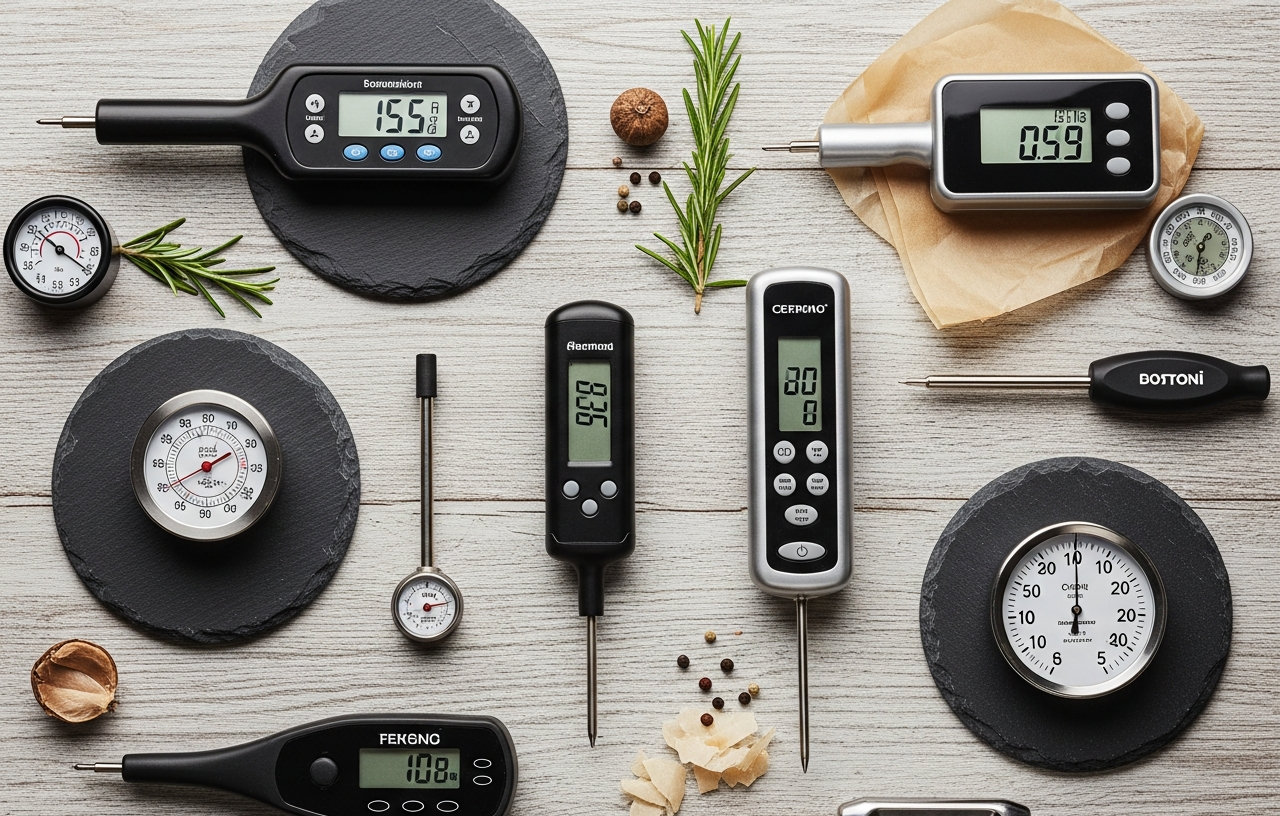
Many home ovens, even new ones, can have internal temperatures that differ significantly from their display settings. This variance, sometimes up to 50 degrees Fahrenheit, can ruin a perfectly good roast or deflate a delicate soufflé. To eliminate guesswork and achieve consistently delicious results, an accurate oven thermometer is an an essential tool. For 2026, we recommend the ThermoSense Pro Digital Probe Thermometer as the top pick. It combines a highly accurate digital display with a durable probe, making it ideal for both ambient oven temperature monitoring and precise internal food temperature tracking.
Why You Need an Accurate Oven Thermometer
Baking and roasting rely heavily on consistent heat. An oven that runs too hot can burn the outside of your food before the inside cooks through. Conversely, an oven that runs too cool extends cooking times and can leave dishes underdone or soggy. Most home ovens are not perfectly calibrated from the factory, and their heating elements can degrade over time. This leads to hot spots and cold spots, or a general inaccuracy across the entire cooking cavity.
Without an independent oven thermometer, you are relying solely on your oven's built-in thermostat, which may not be precise. A dedicated thermometer provides a true reading of the ambient temperature inside your oven, allowing you to adjust your oven's dial accordingly. This simple tool can elevate your cooking from hit-or-miss to consistently excellent, saving you from wasted ingredients and disappointing meals.
How to Test Your Oven's Accuracy
Before buying a new thermometer, you can perform a quick check of your oven's current state. Place a reliable oven thermometer in the center of your oven. Set the oven to a moderate temperature, such as 350°F (175°C), and allow it to preheat for at least 20-30 minutes after the preheat light indicates it's ready. Observe the thermometer's reading over another 15-20 minutes. If the reading consistently deviates by more than 25°F (14°C) from your set temperature, your oven has a calibration issue. For more detailed troubleshooting if your oven is not heating up properly, explore our dedicated guide on oven performance.
Some ovens allow for manual calibration adjustments in their settings, often found in the user manual. If not, a high quality oven thermometer becomes your constant companion, helping you compensate for any temperature discrepancies by simply setting your oven higher or lower than the recipe suggests.
Best Oven Thermometers of 2026
The ThermoSense Pro Digital Probe Thermometer (TOP PICK)
The ThermoSense Pro stands out for its dual functionality and precision. It features a durable, heat-resistant probe that can be inserted into meats or casseroles to monitor internal food temperature, while its main unit displays both the food's temperature and the ambient oven temperature. A long, braided wire connects the probe to the external display, allowing you to read temperatures without opening the oven door and losing heat. This model often includes programmable alarms for desired food doneness and a timer function.
- Pros:
- Exceptional accuracy for both internal food and ambient oven temperatures.
- External display prevents heat loss from opening the oven.
- Programmable alarms make precise cooking easier.
- Durable construction, researched from user reviews.
- Cons:
- Requires batteries for operation.
- The probe wire must be carefully routed to avoid pinching or damage.
Best for: Serious home cooks, bakers, and anyone who frequently roasts large cuts of meat or bakes delicate items requiring exact temperatures. This thermometer eliminates guesswork for both oven calibration and food doneness.
The Classic Dial Oven Thermometer
This traditional style of oven thermometer offers simplicity and reliability. Typically made from stainless steel, it features a large, easy-to-read dial with temperature markings. These thermometers usually have a hook for hanging from an oven rack or a flat base for standing upright. They are entirely mechanical, requiring no batteries or external power.
- Pros:
- Completely self-contained, no batteries needed.
- Durable stainless steel construction, based on product specs.
- Easy to hang or stand on an oven rack.
- Cons:
- Requires opening the oven door to read the temperature, causing heat loss.
- Readings can be less precise than digital models.
- Dial can be difficult to read through a steamy oven door.
Best for: Everyday home cooks who need a general sense of their oven's accuracy and prefer a simple, no-fuss tool. It is also an excellent backup thermometer.
The Wireless Smart Oven Thermometer
For those who appreciate modern technology in the kitchen, a wireless smart oven thermometer offers ultimate convenience. These devices typically consist of a probe that stays inside the oven and a base unit that transmits data wirelessly to a smartphone app. The app allows users to monitor temperatures, set alerts, and track cooking progress from another room. Some models even connect to home Wi-Fi for remote monitoring.
- Pros:
- Monitor temperatures remotely via a smartphone app.
- Provides detailed temperature graphs and alerts.
- Reduces the need to open the oven door.
- Cons:
- Relies on battery power for both probe and base unit.
- Can experience connectivity issues with Wi-Fi or Bluetooth, depending on home setup.
- Setup can be more involved than simpler models.
Best for: Tech-savvy cooks, those who enjoy multi-tasking while cooking, or individuals who frequently entertain and need to monitor dishes without being confined to the kitchen.
The Commercial-Grade heavy duty Oven Thermometer
Designed for demanding environments, commercial-grade oven thermometers prioritize durability and consistent performance. These often feature robust stainless steel casings, larger dials, and heavy duty sensors built to withstand high temperatures and frequent use. While they might resemble the classic dial thermometer in appearance, their internal components and build quality are typically superior, offering enhanced longevity and often better accuracy over time, based on manufacturer data.
- Pros:
- Exceptional durability and longevity.
- Often provides highly accurate readings.
- Built to withstand professional kitchen conditions.
- Cons:
- Can be bulkier than standard home models.
- May still require opening the oven door to read the dial.
Best for: Avid bakers, professional chefs, or anyone who values extreme durability and precise, long term temperature monitoring in a heavy-use kitchen environment. This type is also suitable for those with older ovens that experience significant temperature fluctuations.
Factors to Consider When Choosing an Oven Thermometer
Selecting the right oven thermometer depends on your specific cooking needs and preferences. Here are the key factors to evaluate:
- Accuracy: The primary purpose of an oven thermometer is to provide correct temperature readings. Look for models that claim a narrow margin of error, typically +/- 5°F or less. Digital thermometers often offer superior accuracy compared to analog dial types.
- Temperature Range: Make sure the thermometer can measure temperatures well within the range your oven operates. Most home ovens reach up to 500-550°F (260-290°C).
- Readability: Can you easily read the display from outside the oven? Large dials, backlit digital displays, or external units connected by a probe are beneficial. Steam and oven lights can sometimes obscure internal readings.
- Durability: Oven interiors are hot environments. Choose thermometers made from heat-resistant materials like stainless steel and tempered glass. Probes should be food-grade and able to withstand sustained high temperatures.
- Mounting Options: Some thermometers hang from racks, others stand on the oven floor, and probe models have external displays. Consider which option best suits your oven layout and cooking style.
- Ease of Use: Digital models might involve setting alarms or connecting to an app. Choose what feels most comfortable for you.
- Power Source: Analog thermometers require no power. Digital models need batteries, which will need occasional replacement. Wireless smart thermometers may require charging or more frequent battery changes.
Maintaining Your Oven for Optimal Performance
An oven thermometer helps you compensate for temperature discrepancies, but regular maintenance can also improve your oven's overall performance and lifespan. Cleaning the interior regularly, checking door seals for leaks, and making sure proper ventilation can all contribute to more consistent heating. For a complete approach to appliance longevity, refer to our Home Appliance Maintenance Checklist, which offers advice for all major appliances, including ovens.
If you suspect a more serious issue with your oven, such as a faulty igniter in a gas oven or a non-heating element in an electric oven, these problems go beyond mere temperature calibration. Addressing these issues often requires specific troubleshooting steps. A reliable oven thermometer is a diagnostic tool as much as a cooking aid. It can confirm if your oven is truly failing to reach temperature or if its internal thermostat is simply inaccurate.
Conclusion
Achieving perfect cooking and baking results starts with knowing your oven's true temperature. Investing in a quality oven thermometer is a small step that yields significant improvements in your kitchen. Whether you opt for the versatile ThermoSense Pro Digital Probe Thermometer, a simple classic dial, or a high-tech wireless model, an accurate reading will transform your culinary endeavors. Say goodbye to burnt edges and undercooked centers, and hello to consistently delicious meals.


