
Upgraded 988284 Refrigerator Thermostat Temperature Control Kit Compatible for True Refrigerators800382 077B6856 Freezer Thermostat, Fit for
- [Refrigerator Temperature Control Kit] 988284 Temperature Control is a mechanical thermostat used in various commercial refrigeration units to provide accurate temperature and readings to avoid food damage.
- 【Fix Symptom】:When your refrigerator is experiencing temperature control issues such as (1) inaccurate temperature readings, (2) unstable temperatures, (3) poor cooling performance, food becoming stale, etc., it's time t
- [Compatible Refrigerator Models] 988284 temperature control kit has good compatibility with the following models of ture refrigerators: TC, TSD, T series, GDM, GEM, G4SM.refrigerator style specific models can refer to th
- The upgraded 2025 model is produced by an original OEM equipment manufacturer, achieving safety, reliability, and performance. The newly upgraded 988284 800382 temperature control kit 077B6856 has a quality far exceeding
- [After sales Service]If you purchase our thermostat, we guarantee to repair and replace it within one year. For any reason, if you are not satisfied, please send us an email requesting a free replacement. This is our gua
Food spoiling too quickly in your refrigerator, or beverages freezing solid, means its temperature settings are off. The ideal refrigerator temperature is 35 to 38 degrees Fahrenheit (1.7 to 3.3 degrees Celsius), and the freezer should be 0 degrees Fahrenheit (-18 degrees Celsius). Maintaining these precise temperatures extends food freshness, prevents bacterial growth, and saves energy.
Why Correct Refrigerator Temperature Matters
Improper temperatures can lead to several problems. If the refrigerator is too warm, bacteria can multiply rapidly, causing food spoilage and potential health risks. If it is too cold, fresh produce might freeze, altering its texture and taste. Frozen foods in the freezer also suffer if temperatures fluctuate too much, leading to freezer burn.
A properly calibrated refrigerator also runs more efficiently. When the temperature is consistently correct, the compressor does not have to work overtime, which reduces energy consumption and extends the appliance's lifespan. This can save you money on utility bills and repair costs over time.
Finding Your Refrigerator's Temperature Controls
Refrigerator temperature controls vary significantly by brand and model. Most modern refrigerators use either digital displays or mechanical dials. Identifying your control type is the first step in making adjustments.
Digital Controls
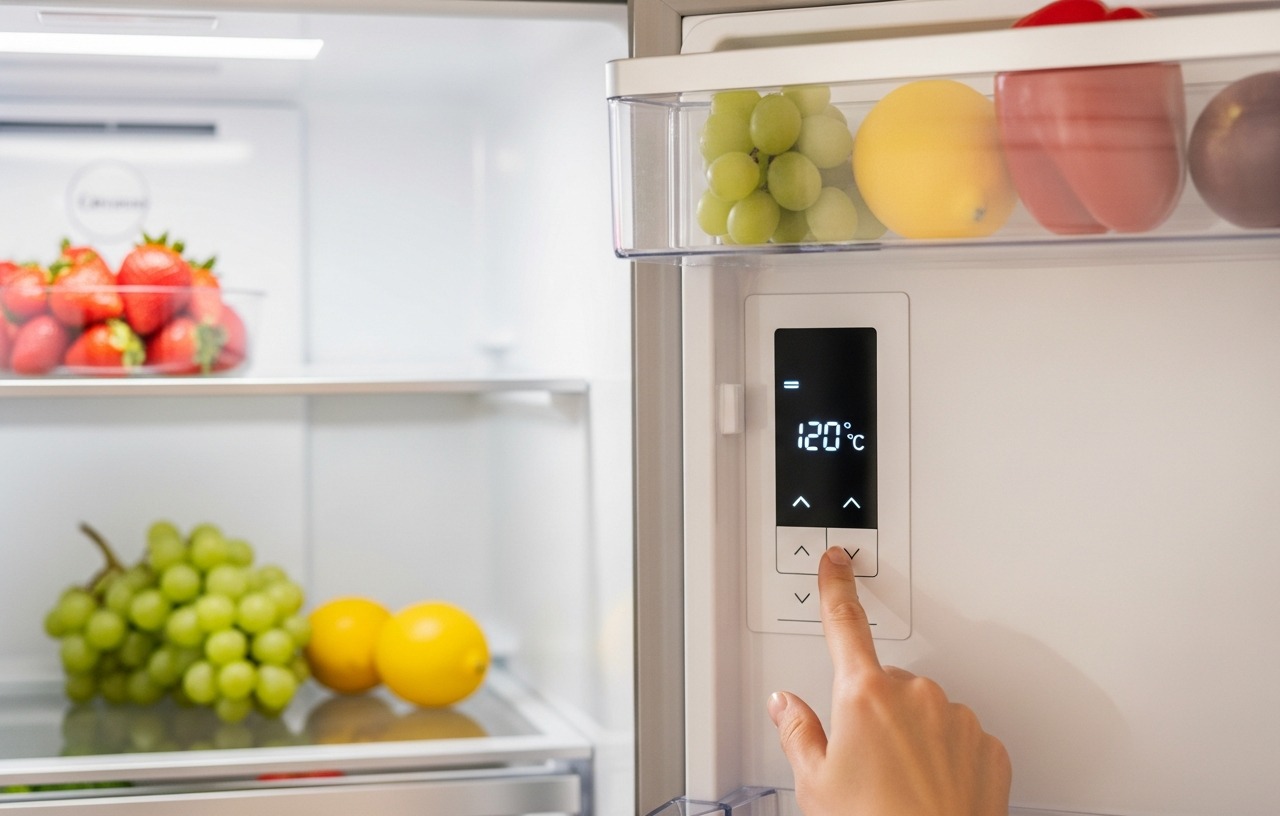
Many newer refrigerators, including most Samsung models, feature digital control panels. These are often located on the front of the refrigerator door, inside the fresh food compartment near the top, or on a dispenser panel. Digital controls typically display the current temperature and allow you to adjust it using up and down arrows or specific temperature buttons.
For example, to adjust temperature on a Samsung fridge, you usually press a "Fridge" or "Freezer" button, then use arrow keys to change the numerical setting. Some Samsung refrigerators have a "Power Cool" or "Power Freeze" option, which temporarily lowers the temperature quickly. Remember to disable these modes after your food has cooled.
Dial Controls
Older or more basic refrigerator models often use mechanical dial controls. These dials might be located inside the fresh food compartment, usually on the back wall or ceiling. They are typically labeled with numbers from 1 to 5 or 1 to 7, where higher numbers usually indicate colder settings. Some dials might use "Cold," "Colder," or "Coldest" labels instead of numbers.
When you adjust a fridge with a dial, you are often adjusting a thermostat that controls the cooling cycles. It takes some trial and error to find the exact temperature you want. Always make small adjustments.
How to Adjust Refrigerator Temperature Settings
Adjusting your refrigerator's temperature is a simple process, but it requires patience to verify the changes. Always refer to your appliance's owner's manual for specific instructions, especially for unique models.
Required Tools and Materials:
- Refrigerator thermometer (digital or analog)
- Owner's manual (if available)
Time Estimate:
Initial adjustment takes 5-10 minutes. Verification can take 24 hours.
- Locate the Controls: Find the digital display or mechanical dial for your fresh food compartment. For a Samsung refrigerator, check the exterior door panel or the inside top panel.
- Understand the Settings: If you have digital controls, you will see numbers representing degrees Fahrenheit or Celsius. For dial controls, higher numbers or "Colder" settings typically mean a lower (colder) temperature.
- Make Small Adjustments: If your food is too warm, lower the temperature by 1-2 degrees Fahrenheit or turn the dial one notch towards a colder setting. If food is freezing, raise the temperature by 1-2 degrees Fahrenheit or turn the dial one notch towards a warmer setting. Avoid drastic changes.
- Wait and Observe: After making an adjustment, wait at least 24 hours for the refrigerator to stabilize at the new setting. Refrigerators do not change temperature instantly.
- Verify with a Thermometer: Place a reliable refrigerator thermometer in the middle of the fresh food compartment, away from vents or the door. Check the reading after 24 hours. The ideal range is 35 to 38 degrees Fahrenheit. Adjust again if needed, waiting another 24 hours.
How to Adjust Freezer Temperature
The freezer usually has its own separate control, though sometimes it is linked to the refrigerator control. The ideal freezer temperature is 0 degrees Fahrenheit (-18 degrees Celsius). This temperature keeps frozen foods safe and prevents freezer burn.
- Locate Freezer Controls: These are often inside the freezer compartment itself, sometimes on the back wall or near the top vent. For many Samsung models, the freezer temperature is adjusted via the same digital panel as the fridge, but you select the "Freezer" option first.
- Adjust Temperature: Use the digital arrows or turn the mechanical dial to adjust the freezer temperature. A higher number on a dial typically means colder.
- Wait and Verify: Allow 24 hours for the freezer temperature to stabilize. Use a freezer-safe thermometer to confirm the temperature is at or near 0 degrees Fahrenheit.
Verifying Temperature Accuracy
Using a dedicated appliance thermometer is the most accurate way to check your refrigerator and freezer temperatures. Do not rely solely on the digital display, as these can sometimes be inaccurate. Place the thermometer in a glass of water in the fresh food compartment for at least 8 hours to get an accurate reading of food temperature, not just air temperature. For the freezer, place it between frozen food packages.
Common Issues Affecting Refrigerator Temperature
Sometimes, adjusting the controls alone does not fix temperature problems. Several other factors can impact your refrigerator's ability to maintain its set temperature.
Door Seals (Gaskets)
Damaged or dirty door seals allow cold air to escape and warm air to enter, forcing your refrigerator to work harder. Inspect the rubber gaskets around both the refrigerator and freezer doors for cracks, tears, or gaps. You can test the seal by closing the door on a dollar bill. If you can pull the bill out easily, the seal is weak and might need cleaning or replacement. A replacement gasket can cost $20 to $100, and you can often install it yourself with basic tools.
Condenser Coils
Dust and debris on the condenser coils restrict airflow and reduce cooling efficiency. These coils are usually located on the back of the refrigerator or underneath, behind a grille. Cleaning them annually can significantly improve performance. Use a vacuum cleaner with a brush attachment to remove accumulated dust. Here is a guide on how to clean refrigerator condenser coils for various brands.
Overfilling or Underfilling
An overpacked refrigerator restricts airflow, preventing cold air from circulating evenly. An underfilled refrigerator, especially the freezer, can struggle to maintain cold temperatures because there is not enough thermal mass to absorb heat. Aim for a refrigerator that is about two-thirds full for optimal performance.
Leveling the Refrigerator
A refrigerator that is not level can cause issues with door sealing and proper drainage, indirectly affecting temperature. If your refrigerator rocks or the doors do not close properly, you might need to adjust its leveling feet. To learn how to level a Samsung fridge, or any brand, you will typically find adjustable feet at the bottom front corners. Use a wrench to turn them up or down until the refrigerator is stable and slightly tilted back for better door closure. A small spirit level helps with accuracy.
Defective Thermostat
If your refrigerator still struggles to maintain temperature after checking other factors, a faulty thermostat might be the cause. A replacement thermostat, like the Upgraded 988284 Refrigerator Thermostat Temperature Control Kit, can fix issues such as inaccurate readings or unstable temperatures. This kit is a mechanical thermostat used in various commercial refrigeration units to provide accurate temperature and readings to avoid food damage. It addresses symptoms like unstable temperatures, poor cooling performance, and food becoming stale. Based on product specs, the 988284 temperature control kit has good compatibility with True Refrigerators (TC, TSD, T series, GDM, GEM, G4SM models). For residential models, you need to verify compatibility with your specific brand and model number. Expect to pay around $30 to $60 for a replacement part. Professional installation could add $100 to $250 in labor, plus a service call fee of $75 to $150.
Evaporator Fan Motor
The evaporator fan circulates cold air from the evaporator coils throughout the freezer and into the fresh food compartment. If this fan fails, the refrigerator will not cool properly, even if the compressor is running. You might hear unusual noises or no fan noise at all. This is a more complex repair, often costing $150 to $300 for parts and labor.
Condenser Fan Motor
The condenser fan pulls air through the condenser coils to dissipate heat. If this fan is not working, the compressor can overheat, and the refrigerator will not cool effectively. You might notice the back of the refrigerator is unusually hot. A replacement can cost $70 to $150 for the part, with professional labor adding $100 to $200.
If your refrigerator is not cooling but the light is on, this points to a specific set of issues, potentially including a faulty compressor, evaporator coils, or a control board problem. Our DIY troubleshooting guide for a refrigerator not cooling but light is on can help diagnose these more complex problems.
When to Call a Professional
If you have tried adjusting the temperature, cleaned the coils, checked the door seals, and verified the leveling, but your refrigerator still does not maintain proper temperatures, it might be time to call a qualified appliance technician. Issues like a faulty compressor, refrigerant leak, or a bad control board are typically beyond the scope of DIY repair for most homeowners. A service call usually costs $75 to $150, and repairs can range from $200 to $800 depending on the part and labor involved. Always get a clear estimate before authorizing any work.
Regular maintenance can prevent many temperature-related problems. Following a home appliance maintenance checklist can save you significant repair costs over your appliance's lifespan.
Upgraded 988284 Refrigerator Thermostat Temperature Control Kit Compatible for True Refrigerators800382 077B6856 Freezer Thermostat, Fit for
- [Refrigerator Temperature Control Kit] 988284 Temperature Control is a mechanical thermostat used in various commercial refrigeration units to provide accurate temperature and readings to avoid food damage.
- 【Fix Symptom】:When your refrigerator is experiencing temperature control issues such as (1) inaccurate temperature readings, (2) unstable temperatures, (3) poor cooling performance, food becoming stale, etc., it's time t
- [Compatible Refrigerator Models] 988284 temperature control kit has good compatibility with the following models of ture refrigerators: TC, TSD, T series, GDM, GEM, G4SM.refrigerator style specific models can refer to th
- The upgraded 2025 model is produced by an original OEM equipment manufacturer, achieving safety, reliability, and performance. The newly upgraded 988284 800382 temperature control kit 077B6856 has a quality far exceeding
- [After sales Service]If you purchase our thermostat, we guarantee to repair and replace it within one year. For any reason, if you are not satisfied, please send us an email requesting a free replacement. This is our gua