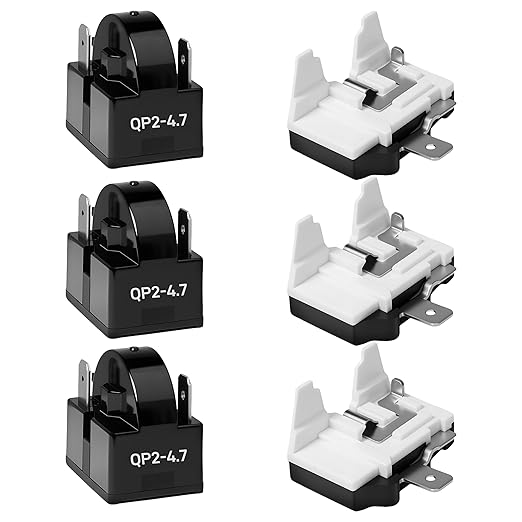
6-Pack QP-02-4.7 Ohm 3-Pin Universal Refrigerator Compressor Start Relay and Overload Protector Kit - Starter with 1/2 HP Overload Compatibl
- 【6-PACK VALUE & CONVENIENCE】 - Get 6 complete repair kits in one order. Perfect for professional repair technicians, appliance service businesses, or homeowners who want reliable spares on hand, saving you time and money
- 【PRECISE COMPATIBILITY & SPECIFICATIONS】 - Features the exact QP-02-4.7 / QP2-4R7 model 3-pin PTC start relay with 4.7 Ohm cold resistance, paired with a 1/2 HP rated overload protector. Ensures perfect fit and function f
- 【WIDE APPLIANCE REPLACEMENT】 - Designed to be compatible with various compact cooling appliances including mini refrigerators, beverage and beer coolers, wine chillers, deep freezers, compact freezers, and other domestic
- 【RESTORE COOLING PERFORMANCE】 - Effectively replaces faulty relays and protectors that cause common cooling issues like compressor humming but not starting, short cycling, or failure to run. A reliable solution to get you
- 【EASY INSTALLATION & SAFETY】 - Simple plug-and-play design for direct connection to standard 3-pin compressor terminals. The included overload protector safeguards your compressor from damage due to overheating or excessi

Mudder QP2-4.7 PTC Starter Relay 1 Pin Refrigerator Starter Relay and 6750C-0005P Overload Protector Compatible with LG Refrigerator Compres
- Package Content: you will get 1 piece of 4.7 Ohm 1 pin PTC start relay and 1 piece of 6750C-0005P refrigerator overload protector, totally 2 pieces for you, convenient to replace the old or broken part of your refrigerat
- Compatible Models: the refrigerator overload protector can prevent the compressor in your refrigerator from overheating, nice to replace part numbers like AP4439459, 1357963, AH3529540, EA3529540, PS3529540, you can chec
- PTC Starter Relay: the PTC start relay is the universal starter relay applied on mini fridges and coolers, saving your time and effort, this item is only compatible with QP2-4.7 one terminal relay, please do consider thi
- Easy to Install: refrigerator starter relay is made of plastic, the overload protector is made of plastic and brass, both materials are durable, reliable and rust resistant, also easy to install for direct replacement, w
- Widely Applied: 4.7 Ohm 1 pin PTC start relay and 6750C-0005P refrigerator overload protector are compatible with most mini fridges, compact refrigerators, beverage and beer coolers, deep freezers, wine refrigerators, wi

GS102 fits Start Relay Device and Overload Kit 2SP100 Replacement for 216008900 Heavy Duty Refrigerator Compressor Protector Universal Upgra
- Easy DIY Installation - The WSRXG GS102 fits start relay device and overload kit 2SP100 replacement for 216008900 can be installed quickly without professional tools or wiring knowledge making it perfect for homeowners a
- Universal Fit for Multiple Models - The WSRXG GS102 fits start relay device and overload kit 2SP100 replacement for 216008900 is compatible with many popular refrigerator compressors making it a versatile and cost effect
- Upgraded Performance Replacement - The WSRXG GS102 fits start relay device and overload kit 2SP100 replacement for 216008900 heavy duty features an upgraded internal design that ensures faster compressor startup and more
- Heavy Duty and Long Lasting - The WSRXG GS102 fits start relay device and overload kit 2SP100 replacement for 216008900 is built with heat resistant copper contacts and a reinforced housing for excellent durability and c
- Enhanced Compressor Protection - The WSRXG GS102 fits start relay device and overload kit 2SP100 replacement for 216008900 provides improved overload protection reducing the risk of electrical damage and extending compre
There's nothing more frustrating than opening your refrigerator to find it warm and your food spoiling. When your refrigerator compressor is not running, it's often the root cause of cooling issues. But before you call an expensive repair technician, many common culprits are surprisingly easy and cheap to fix yourself.
The compressor is the heart of your refrigerator's cooling system. If it's silent or making unusual noises without actually running, it's a clear sign of trouble. The good news is that the compressor itself isn't always the problem. Often, it's a smaller, less expensive component preventing it from doing its job.
In this guide, we'll walk you through the most common reasons why your refrigerator compressor is not running, starting with the simplest and cheapest fixes first. We'll cover everything from basic power checks to diagnosing the compressor's vital support components, like the start relay. Many of these repairs can be done with basic tools and a little confidence, potentially saving you hundreds of dollars.
Safety First: Always Unplug Your Fridge
Before you begin any troubleshooting or repair, always unplug your refrigerator from the wall outlet. Electricity can be dangerous, and working with live components can lead to serious injury or even death. Once unplugged, wait a few minutes for any residual charge in capacitors to dissipate.
Common Reasons Your Refrigerator Compressor Is Not Running
When the compressor on your refrigerator not running, it usually points to one of these issues:
- Power Supply Problems: No power to the fridge.
- Faulty Start Relay or Overload Protector: The most common and cheapest fix.
- Dirty Condenser Coils: Overheating the compressor.
- Malfunctioning Fan Motors: Condenser or evaporator fans.
- Bad Start Capacitor: Prevents the compressor from starting.
- Temperature Control Issues: Thermostat or control board failure.
- A Failed Compressor: The most expensive scenario, often requiring professional help.
Let's tackle these one by one.
1. Check Power Supply and Basic Settings (Cost: $0)
It might sound obvious, but sometimes the simplest solutions are the right ones. If your fridge compressor not working, start here:
Is the Refrigerator Plugged In and Power On?
Make sure the power cord is securely plugged into a working outlet. Test the outlet with another appliance, like a phone charger or a lamp, to confirm it has power. If the outlet is dead, check your home's circuit breaker box for a tripped breaker. Flip it off, then back on firmly.
Is the Thermostat Set Correctly?
Accidentally bumped the temperature dial? Ensure your refrigerator's thermostat is set to a sufficiently cold temperature, usually between 35-38 degrees Fahrenheit for the fresh food section and 0 degrees Fahrenheit for the freezer. If the fridge thinks it's already cold enough, the compressor won't run.
Are the Door Seals Intact?
If your door seals (gaskets) are cracked or torn, warm air can continuously leak into the fridge, causing the compressor to run constantly or struggle to maintain temperature. While this might not directly cause the compressor to stop, it can overwork it. Check the seals for damage and ensure the doors close tightly. For more general cooling issues, you might find our guide on Refrigerator Not Cooling But Light Is On? DIY Troubleshooting Guide helpful.
2. Test the Start Relay and Overload Protector (Cost: $8-$20)
This is by far the most common reason a refrigerator compressor is not running, especially if you hear a clicking sound but no hum from the compressor itself. The start relay and overload protector are small, relatively inexpensive parts that work together to get the compressor running and protect it from overheating.
What They Do:
- Start Relay: Provides a temporary power boost to the compressor's start winding to help it overcome initial resistance and begin spinning. Once the compressor is running, the relay disconnects the start winding.
- Overload Protector: A safety device that monitors the current and temperature of the compressor. If the compressor draws too much current or gets too hot, the overload protector will trip, shutting off power to prevent damage. This often causes the clicking sound you might hear before the compressor tries to start again.
Location:
Both components are usually found together, attached to the side of the compressor itself. You'll typically need to remove a small cover panel on the back of your refrigerator, near the bottom, to access them.
How to Test Them:
- Unplug the refrigerator.
- Access the compressor: Gently pull the refrigerator away from the wall and locate the compressor, usually a large, black, cylindrical component at the bottom rear.
- Remove the cover: There will be a small plastic or metal cover over the compressor terminals, held by clips or screws. Carefully remove it.
- Remove the start relay and overload protector: These will be plugged onto the compressor's pins. Gently pull them straight off.
- Inspect for rattling: Hold the start relay in your hand and shake it gently. If you hear a distinct rattle, it likely means an internal component has broken, and the relay needs replacement. This is a common failure.
- Check for continuity (optional, with a multimeter): For a more precise test, use a multimeter set to the Rx1 (resistance) setting. Touch the probes to the relay's terminals. You should get a reading of continuity. If it's open (no reading), the relay is bad. The overload protector should also show continuity.
Replacement:
If either part is faulty, replacing them is straightforward. They often come as a kit. A new start relay and overload protector kit typically costs between $8 and $20. It's a fantastic first step when your fridge compressor not running.
"I always tell my customers to check the start relay first," says Mark Jensen, a lead appliance technician at Cool Home Repairs. "Nine times out of ten, if the compressor is silent or just clicking, a new relay kit will get it humming again. It's such a cheap fix, it's worth trying before anything else."
For many compact cooling appliances, a universal kit can do the trick. Our TOP PICK is the 6-Pack QP-02-4.7 Ohm 3-Pin Universal Refrigerator Compressor Start Relay and Overload Protector Kit. This kit offers incredible value, providing six complete repair kits, perfect for homeowners who want spares or for professional technicians. It features the exact QP-02-4.7 / QP2-4R7 model 3-pin PTC start relay with 4.7 Ohm cold resistance and a 1/2 HP rated overload protector, ensuring a precise fit and function for a wide range of mini refrigerators, beverage coolers, wine chillers, and compact freezers.
Other reliable options include the Mudder QP2-4.7 PTC Starter Relay 1 Pin Refrigerator Starter Relay and 6750C-0005P Overload Protector, which is compatible with LG refrigerators and specific part numbers. There's also the GS102 fits Start Relay Device and Overload Kit 2SP100 Replacement for 216008900, a heavy duty universal upgrade designed for easy DIY installation without professional tools.
3. Clean Dirty Condenser Coils (Cost: $0 or $75-$150)
Dirty condenser coils can cause your refrigerator compressor to overheat, leading the overload protector to trip and shut down the compressor. If your fridge compressor not running, or if it's running but not cooling well, this is a common problem.
What They Do:
The condenser coils release heat from the refrigerant into the surrounding air. If they're covered in dust, pet hair, and grime, they can't dissipate heat effectively.
Location:
Condenser coils are usually located at the back of the refrigerator, either visible or beneath a cover panel, or sometimes underneath the fridge behind the front kickplate.
How to Clean Them:
- Unplug the refrigerator.
- Locate the coils: Depending on your model, you might need to remove the back lower access panel or the front kickplate.
- Vacuum and brush: Use a vacuum cleaner with a brush attachment to remove dust and debris from the coils. A specialized condenser coil brush can help reach tight spots.
This is a free DIY fix that can significantly improve your refrigerator's efficiency and prevent the compressor from overheating. If you hire a professional for this task, expect to pay around $75-$150 for cleaning. For a detailed guide, see our article on How to clean refrigerator condenser coils.
4. Check the Condenser Fan Motor (Cost: $30-$100 part, $50-$150 labor)
If the condenser coils are clean but the compressor is still overheating or the fridge compressor not working, the condenser fan motor might be faulty.
What It Does:
This fan draws air over the condenser coils to help cool them and the compressor. If it's not working, heat builds up, and the compressor's overload protector will trip.
Location:
The condenser fan is usually located near the compressor and condenser coils, at the bottom rear of the refrigerator.
How to Test It:
- Unplug the refrigerator.
- Access the fan: Remove the lower rear access panel.
- Inspect for obstructions: Check if anything is physically blocking the fan blades. Remove any debris.
- Spin the blade by hand: The blade should spin freely. If it's stiff or wobbly, the motor bearings might be bad.
- Check for power (caution): If you're comfortable and have a multimeter, you can temporarily plug the fridge back in (for a very short period) and check for voltage at the fan motor terminals. If there's power but the fan isn't spinning, the motor is likely bad. Remember to unplug it immediately after testing.
Replacement:
If the motor is faulty, you'll need to replace the entire motor assembly. A new condenser fan motor typically costs $30-$100. Professional labor for this repair usually adds $50-$150.
5. Inspect the Evaporator Fan Motor (Cost: $50-$150 part, $75-$200 labor)
While less directly related to the compressor starting, a failed evaporator fan can lead to poor cooling and might confuse diagnostics, making it seem like the fridge compressor not running effectively.
What It Does:
The evaporator fan circulates cold air from the freezer evaporator coils into both the freezer and fresh food compartments. If it fails, the fresh food section won't cool, even if the compressor and condenser fan are working.
Location:
The evaporator fan is located inside the freezer compartment, usually behind a rear panel.
How to Test It:
- Unplug the refrigerator.
- Access the fan: Empty the freezer and remove the rear panel inside the freezer compartment.
- Inspect for obstructions: Look for ice buildup or other debris blocking the fan blades.
- Spin the blade by hand: The fan blade should spin freely. If it's stiff, the motor is likely seized.
- Listen: If you open the freezer door, the fan should stop. If you push the door switch (the button that turns off the light), you should hear the fan start up again. No sound usually indicates a problem.
Replacement:
Replacing an evaporator fan motor is a moderate DIY task. The part itself costs around $50-$150, and professional installation could add $75-$200.
6. Check the Start Capacitor (Cost: $10-$30)
Some refrigerator compressors use a start capacitor in conjunction with the start relay to provide an extra jolt of electricity to help the compressor get going. If this capacitor fails, the compressor might hum but never fully start, or it won't attempt to start at all.
What It Does:
The capacitor stores an electrical charge and releases it rapidly to provide a powerful boost to the compressor's start winding.
Location:
Often located near the compressor and start relay, sometimes housed within the same assembly or in a separate canister.
How to Test It:
- Unplug the refrigerator.
- Locate the capacitor: Identify the cylindrical capacitor, usually attached to the compressor area.
- Discharge the capacitor: Capacitors can hold a dangerous electrical charge even when unplugged. Using a screwdriver with an insulated handle, short the capacitor's terminals by touching the metal shaft across both terminals simultaneously. You might see a spark, which is normal.
- Test with a multimeter: Set your multimeter to measure capacitance (if it has this function). Touch the probes to the capacitor terminals. A healthy capacitor will show a reading close to its specified microfarad (uF) rating. If it reads zero or significantly off, it's bad.
Replacement:
A new start capacitor is relatively inexpensive, typically costing $10-$30. Replacement is a fairly simple swap once the old one is safely discharged.
7. Temperature Control Thermostat or Control Board (Cost: $20-$80 for thermostat, $100-$300 for board)
If the refrigerator compressor is not running because the fridge isn't calling for cooling, the issue could be with the temperature sensing and control system.
What They Do:
- Thermostat: A mechanical or electronic switch that senses the internal temperature and tells the compressor when to turn on and off.
- Control Board (Main Control Board): The electronic brain of modern refrigerators, managing all functions, including the compressor, fans, and defrost cycle.
How to Test Them:
- Thermostat: You can often test a mechanical thermostat for continuity with a multimeter. Turn the dial to the coldest setting. If there's no continuity, it's likely faulty.
- Control Board: Diagnosing a control board is more challenging. Look for visual signs of damage, such as burnt spots or bulging capacitors. Often, if all other components test good and the fridge is completely dead or acting erratically, the control board is suspected.
Replacement:
Replacing a mechanical thermostat is usually a simple DIY task, costing $20-$80 for the part. A control board replacement is more complex and expensive, with parts ranging from $100-$300. Professional labor for a control board can add another $100-$250, making it a more significant repair.
8. The Compressor Itself Has Failed (Cost: $150-$600 part, $200-$500+ labor)
This is the least desirable outcome, as a failed compressor is the most expensive component to replace. If you've systematically ruled out all the above, and your fridge compressor not working, then the compressor itself might be the problem.
Signs of a Bad Compressor:
- Compressor hums or clicks repeatedly but never starts.
- Compressor is completely silent, and all other components (relay, fans, thermostat) test good.
- Compressor runs for a short time, then shuts off (often due to internal winding issues or a hard start kit failing to fix it).
- The compressor is extremely hot to the touch (after being unplugged for safety).
How to Test It:
Testing the compressor involves checking the resistance across its electrical windings with a multimeter. There are typically three pins on the compressor: run, start, and common. You'll measure the resistance between common and run, common and start, and run and start. The sum of the common-run and common-start readings should equal the run-start reading. If any readings are open (infinite resistance) or significantly deviate, the compressor is likely bad.
Replacement:
Compressor replacement is a highly technical job that requires specialized tools, including refrigerant recovery equipment, welding gear, and vacuum pumps. It's definitely not a DIY project for the average homeowner. The cost of a new compressor part alone can range from $150 to $600 or more, depending on the fridge model. Professional labor will add another $200-$500 or even higher, bringing the total repair cost to $350-$1100 or more.
"When the compressor itself fails, it's a tough call," explains Sarah Chen, owner of Reliable Appliance Repair Services. "For older refrigerators, say 7-10 years old, the cost of a compressor replacement often comes close to or exceeds the cost of a brand new, energy-efficient fridge. In those cases, I usually advise customers to consider replacing the entire appliance."
When to Call a Professional
You've successfully handled many of these checks. However, there are clear times when professional help is needed:
- Refrigerant Leaks: If you suspect a refrigerant leak (e.g., a sweet chemical smell, oily residue), this is a job for certified technicians only.
- Compressor Replacement: As discussed, replacing the compressor requires specialized tools and licensing.
- Complex Electrical Issues: If you're uncomfortable with electrical testing or can't pinpoint the problem after basic checks, it's safer to call an expert.
- Cost vs. Age: If the repair cost, especially for a compressor, approaches or exceeds 50% of the cost of a new refrigerator, it's often more economical to invest in a new appliance.
Conclusion
When your fridge compressor not working, it can feel like a major disaster. However, by systematically troubleshooting the common causes, starting with the simplest and cheapest fixes like the start relay, you can often diagnose and repair the problem yourself. Remember to prioritize safety by always unplugging the appliance before you begin. With a little patience and the right information, you can get your refrigerator back to cooling efficiently and save yourself a significant repair bill.
6-Pack QP-02-4.7 Ohm 3-Pin Universal Refrigerator Compressor Start Relay and Overload Protector Kit - Starter with 1/2 HP Overload Compatibl
- 【6-PACK VALUE & CONVENIENCE】 - Get 6 complete repair kits in one order. Perfect for professional repair technicians, appliance service businesses, or homeowners who want reliable spares on hand, saving you time and money
- 【PRECISE COMPATIBILITY & SPECIFICATIONS】 - Features the exact QP-02-4.7 / QP2-4R7 model 3-pin PTC start relay with 4.7 Ohm cold resistance, paired with a 1/2 HP rated overload protector. Ensures perfect fit and function f
- 【WIDE APPLIANCE REPLACEMENT】 - Designed to be compatible with various compact cooling appliances including mini refrigerators, beverage and beer coolers, wine chillers, deep freezers, compact freezers, and other domestic
- 【RESTORE COOLING PERFORMANCE】 - Effectively replaces faulty relays and protectors that cause common cooling issues like compressor humming but not starting, short cycling, or failure to run. A reliable solution to get you
- 【EASY INSTALLATION & SAFETY】 - Simple plug-and-play design for direct connection to standard 3-pin compressor terminals. The included overload protector safeguards your compressor from damage due to overheating or excessi
Mudder QP2-4.7 PTC Starter Relay 1 Pin Refrigerator Starter Relay and 6750C-0005P Overload Protector Compatible with LG Refrigerator Compres
- Package Content: you will get 1 piece of 4.7 Ohm 1 pin PTC start relay and 1 piece of 6750C-0005P refrigerator overload protector, totally 2 pieces for you, convenient to replace the old or broken part of your refrigerat
- Compatible Models: the refrigerator overload protector can prevent the compressor in your refrigerator from overheating, nice to replace part numbers like AP4439459, 1357963, AH3529540, EA3529540, PS3529540, you can chec
- PTC Starter Relay: the PTC start relay is the universal starter relay applied on mini fridges and coolers, saving your time and effort, this item is only compatible with QP2-4.7 one terminal relay, please do consider thi
- Easy to Install: refrigerator starter relay is made of plastic, the overload protector is made of plastic and brass, both materials are durable, reliable and rust resistant, also easy to install for direct replacement, w
- Widely Applied: 4.7 Ohm 1 pin PTC start relay and 6750C-0005P refrigerator overload protector are compatible with most mini fridges, compact refrigerators, beverage and beer coolers, deep freezers, wine refrigerators, wi
GS102 fits Start Relay Device and Overload Kit 2SP100 Replacement for 216008900 Heavy Duty Refrigerator Compressor Protector Universal Upgra
- Easy DIY Installation - The WSRXG GS102 fits start relay device and overload kit 2SP100 replacement for 216008900 can be installed quickly without professional tools or wiring knowledge making it perfect for homeowners a
- Universal Fit for Multiple Models - The WSRXG GS102 fits start relay device and overload kit 2SP100 replacement for 216008900 is compatible with many popular refrigerator compressors making it a versatile and cost effect
- Upgraded Performance Replacement - The WSRXG GS102 fits start relay device and overload kit 2SP100 replacement for 216008900 heavy duty features an upgraded internal design that ensures faster compressor startup and more
- Heavy Duty and Long Lasting - The WSRXG GS102 fits start relay device and overload kit 2SP100 replacement for 216008900 is built with heat resistant copper contacts and a reinforced housing for excellent durability and c
- Enhanced Compressor Protection - The WSRXG GS102 fits start relay device and overload kit 2SP100 replacement for 216008900 provides improved overload protection reducing the risk of electrical damage and extending compre